
Search engine optimization software has quietly become one of the most important tools in digital marketing and business growth. If you've ever built a website, you already know the uncomfortable truth: launching the site is the easy part. Getting it to actually pull in traffic is where most projects quietly die.
I'm John, and I run my analysis on data, not vibes. I'm not the guy who'll tell you a tool is "great" because the dashboard looks pretty. I want to see whether the numbers a tool reports line up with the numbers in my own Google Analytics. That obsession with data didn't come for free, though. It came from one of the most expensive mistakes of my life.
The short version of my story: Back in 2020, I poured over $1,000,000 (in local currency terms, well into seven figures USD-adjusted over the project's life) into a content site and an outsourced SEO team. We were weeks from profitability. Then a Google algorithm update wiped out 70% of my traffic in a single day. I spent five more months and tens of thousands of dollars trying to claw it back, failed, and shut the whole thing down. Everything I recommend below was tested in the aftermath, when I rebuilt from scratch and refused to ever fly blind again.
Here's the first lesson I paid dearly for: SEO ranking growth is painfully slow. In competitive markets like the US, UK and Western Europe, you don't measure keyword progress week to week. You measure it quarter to quarter. Anyone promising you page-one rankings in 30 days is either lying or about to get you penalized. The right software won't make Google faster, but it will stop you from wasting months pushing on tactics that were already dead.
The 5 Best SEO Tools in the World (And What Each One Is Actually For)
Here's something nobody tells beginners: there is no single "best" SEO tool. Each of the serious platforms has a specialty it does better than anyone else. After buying all of them with my own money and cross-checking every number against my real analytics, here's how I'd rank and assign them.
| Tool | Best For | My Data-Match Verdict | Who It's For |
|---|---|---|---|
| SEMrush | All-around SEO + competitive intel | Closest to my real GA data | Serious marketers, agencies |
| Ahrefs | Backlink discovery | Fastest, deepest link index | Link-builders, SEO pros |
| Mangools | Keyword research on a budget | Great for finding gaps | Beginners, small businesses |
| SimilarWeb | Market & traffic intelligence | The most complete database | Enterprises, market analysts |
| Bing Webmaster | Free baseline SEO checks | Limited but genuinely free | Anyone starting out |
1. The Most Complete SEO Tool: SEMrush
My experience: Honestly, I didn't expect to land here. Going in, I assumed I'd prefer Mangools for the price and Ahrefs for backlinks. But once I bought all three and ran them side by side against my own Google Analytics dashboard, SEMrush's numbers were consistently the closest to my real traffic data. If you forced me to keep only one tool, this is the one.
That data-match is the whole reason I trust it. When a tool tells me a keyword gets 8,000 searches a month and my actual analytics roughly agree once I rank for it, I can plan a content budget around that. When a tool is off by 3x, I'm just gambling. SEMrush gambled the least.
What SEMrush does well:
- Deep keyword research with search volume, trends, competition level and cost-per-click data
- Genuinely useful competitor analysis: you can pull apart a rival's keywords, top pages, backlinks and even their paid ad campaigns
- A site audit module that flags technical issues and concrete optimization opportunities
- Backlink tools that show you the source's authority, traffic and social influence, so you know which links are worth chasing
- Content marketing support with recommendations on keyword usage and engagement
Founded back in 2008, SEMrush bundles SEO, competitive intelligence, content marketing and PPC into a single platform now used by millions of marketers worldwide. For most people reading this, it's the safest "if I only buy one" choice.
2. The Best Tool for Backlinks: Ahrefs
My experience: Ahrefs pioneered its own web crawler, and in my testing it still has the fastest, most aggressive backlink crawling of any tool I've used. A link published today on a high-traffic site can show up in their index almost immediately. I tell everyone to at least register a free account just to get real-time alerts when something changes in your backlink profile.
If link building is your game, Ahrefs is hard to beat. Their crawler is the backbone of everything, and it's why their link data feels alive rather than stale.
What Ahrefs does well:
- One of the largest backlink indexes on the planet, backed by a keyword database in the tens of billions
- Strong keyword research with search volume, click-through estimates and keyword difficulty scores
- An efficient site audit tool that catches technical problems: meta tags, URL structure, internal linking and more
- Real-time monitoring of ranking changes, new and lost backlinks, and competitor moves, with reporting you can customize
If you ever want to go deeper on how Ahrefs stacks up against my top pick, I wrote a full head-to-head here: Ahrefs vs SEMrush.
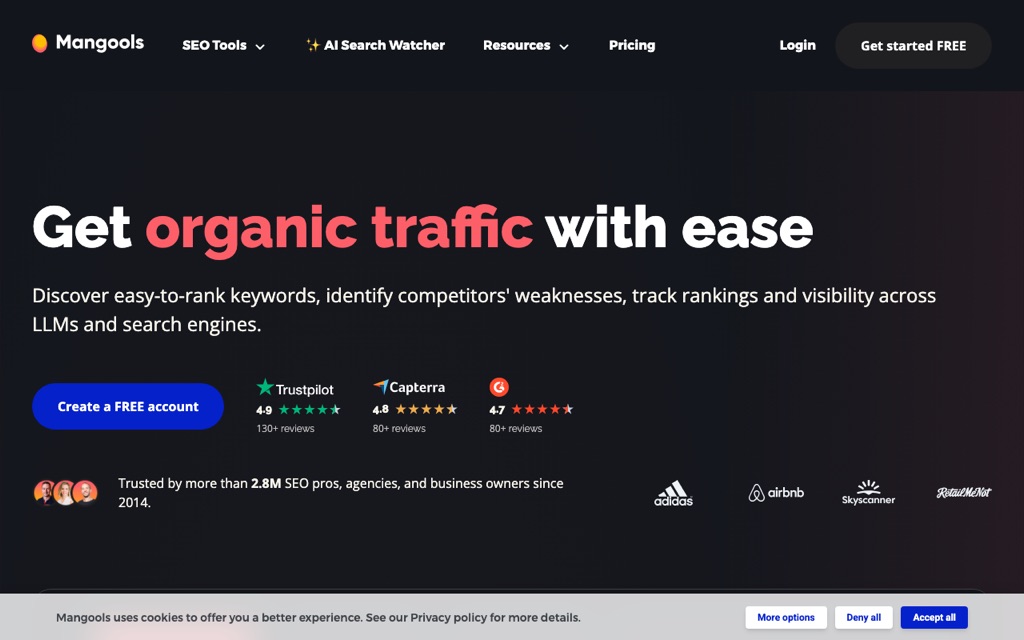
3. The Best Keyword Analysis Tool: Mangools
My experience: Mangools started life as KWFinder, and keyword research is still where it shines. For sniffing out low-competition keywords that everyone else has overlooked, it punches well above its price. The rest of its features are fine, nothing more, but the keyword tool alone justifies the subscription for a lot of people.
What Mangools does well:
- An intuitive, friendly interface with almost no learning curve, which matters more than experts admit
- Professional keyword research through KWFinder, surfacing search volume, competition and cost data so you can build a real SEO strategy instead of guessing
My honest take: Mangools is the sweet spot for beginners and small-to-medium businesses. It's simple enough that you won't be intimidated, professional enough that the data is trustworthy, and cheap enough that it won't hurt. If you want the full walkthrough, I covered it in detail here: Mangools & KWFinder review.
4. The Most Complete Database: SimilarWeb
My experience: SimilarWeb is, plainly, the most comprehensive website database I've ever used. I've sat in meetings with their reps and run their enterprise tier (which ran roughly $50,000 a year). What sets it apart for anyone with international ambitions is reach: it's one of the very few tools that gives you meaningful data on markets that operate semi-independently from the Western web, including the Chinese internet. If you connect your own Google Analytics to it, the accuracy gets even better.
This is the tool I reach for when I'm thinking like a strategist rather than a tactician. It's less "which keyword should I write about today" and more "what does this entire market look like, and where is the traffic actually flowing."
What SimilarWeb does well:
- Full traffic analysis: visits, page views, bounce rate and average session duration
- Traffic source breakdown across direct, search, social, email and paid channels
- Competitive analysis of rivals' traffic, user behavior and marketing strategy
- Industry trends and market intelligence, including market share and competitor benchmarks
- Geographic and demographic analysis so you can target the right markets and audiences
For comprehensive data, competitive intelligence and big-picture industry insight, SimilarWeb is the most powerful option here, as long as your budget can stomach it.
5. The Best Free SEO Tool: Bing Webmaster Tools
My experience: A genuinely useful free SEO tool is rare. Bing Webmaster Tools is one of them. Yes, the feature set is limited and the accuracy lags behind the paid platforms, but for keyword analysis and basic backlink discovery at a price of exactly zero, it's worth setting up on day one.
Bing Webmaster Tools also runs SEO evaluations and hands you optimization recommendations based on Bing's own best practices. It won't replace SEMrush or Ahrefs, but if you're just starting and can't justify a subscription yet, there's no reason not to use it.
The Best WordPress SEO Plugins
Everything above lives outside your site. But on-page SEO, the stuff that happens inside WordPress itself, matters just as much. Here are the two plugins I actually install on every WordPress site I build.
1. All in One SEO (AIOSEO)
My experience: AIOSEO has one of the most thoughtfully designed interfaces in the category. It's friendly to beginners and gives you page-by-page improvement suggestions you can actually act on. The Pro version is genuinely powerful and worth it if you're serious about pushing your on-page SEO scores up.
Out of the box it handles XML sitemaps, a robots.txt editor, social media integration and redirect management, all of which feed into better search visibility and rankings.
2. Yoast SEO
My experience: Yoast is the most popular SEO plugin on WordPress for a reason. Here's the detail most people miss: the free version includes Schema markup, and it's one of the only free SEO plugins that does. For a budget-conscious solo site, that's a real edge.
Yoast gives you real-time content analysis to optimize your titles, URLs and meta descriptions, plus XML sitemaps, breadcrumb navigation and internal linking suggestions. Between AIOSEO and Yoast, you can't really go wrong, but I lean Yoast for free projects and AIOSEO when a client is paying.
Website SEO: The Million-Dollar Lesson I Paid For
I've referenced this story a few times, so let me lay out the whole thing. Not to wallow in it, but because the numbers are the most honest argument I can make for using real data tools instead of trusting an outsourced team blindly.
The Setup
In 2020 I went all-in on a content website. Roughly speaking, here's what it cost me:
- Website development: about $1,500
- Servers and backend: around $650 per year
- Ranking optimization (the outsourced SEO team): $10,000 per month
That last number is the one that hurts to type. Ten thousand dollars a month, handed to a team I trusted to make the right calls.
The Growth Phase
And for a while, it worked. Between October and December 2020, the site hit:
- 556,000 searches
- 25,900 visitors
- Estimated monthly revenue: ~$13,000
- Monthly costs: ~$12,000
We were basically at break-even with a clear upward trajectory. My projection had us clearing $30,000 in monthly profit by sometime in 2021. I genuinely thought I'd cracked it.
The Crash
Then, on December 3, 2020, Google rolled out one of its core algorithm updates. The result was brutal and immediate:
- Traffic fell by 70%
- Daily visitors collapsed to around 265
- Monthly revenue dropped to roughly $8,000
- Which no longer came close to covering $12,000 in monthly costs
Overnight, a near-profitable business became a money-losing one. And here's the part that still stings: my outsourced team never saw it coming, because they weren't watching the data. They were executing a playbook that Google had just retired.
The Recovery That Never Came
Over the next five months, my partners and I did everything you're "supposed" to do:
- Swapped out the optimization team
- Brought in additional consultants
- Spent another ~$80,000 trying to recover
The return on all of that? About 42,400 visitors and roughly $42,400 in revenue over the whole period. We were pouring money into a hole. Eventually I added it all up: total losses well over $1,000,000 across the project's life. And then I did the only rational thing left. I shut the website down.
The real takeaway: I didn't lose that money because SEO doesn't work. I lost it because I outsourced my judgment to people who weren't watching the data, and I had no independent way to verify what they were doing. The algorithm change was the trigger, but flying blind was the actual cause.
How You Avoid My Mistake
The lesson cost me seven figures, so let me give it to you for free. Use SEO software to do your own keyword analysis and on-page optimization, so that when Google updates its algorithm, you can see the shift in your own data and adapt, instead of finding out months later when the revenue's already gone.
If you're a company, do not rely solely on an external optimization team. Use data-driven SEO tools yourself, or at minimum keep them running in parallel so you can check the team's work against reality. Every tool I recommended above earns its place because its numbers held up when I checked them against my real analytics. That's the whole standard. If a tool can't survive a reality check, it has no business setting your strategy.
Start with one tool. If you can only buy one, make it SEMrush, since it tracked closest to my real data. Add Ahrefs when backlinks become your priority, lean on Mangools if you're on a budget, and bring in SimilarWeb when you're thinking about whole markets. But whatever you do, watch your own numbers. I learned that lesson the most expensive way there is.