
Back in 2020, I did something I'm honestly still a little embarrassed about. I hired an outside agency, signed a contract that promised "full SEO support," and over the following year I poured a six-figure budget into a team that was supposed to make my site rank. I'm John, and if you've read anything else I've written, you know I'm the data guy who trusts spreadsheets over sales pitches. But back then I trusted the wrong people.
Then Google rolled out a core algorithm update. My rankings didn't dip. They collapsed. I watched my organic sessions in Google Analytics fall off a cliff over about three weeks, and with them went a meaningful chunk of revenue. When I asked the agency what happened, I got a slide deck full of jargon and zero answers. That was the moment I learned the lesson that shaped everything I do now.
The lesson I paid a fortune for: Instead of throwing money at a black box you can't audit, learn to use the right tools yourself and do the keyword research properly. Whoever owns the data owns the strategy.
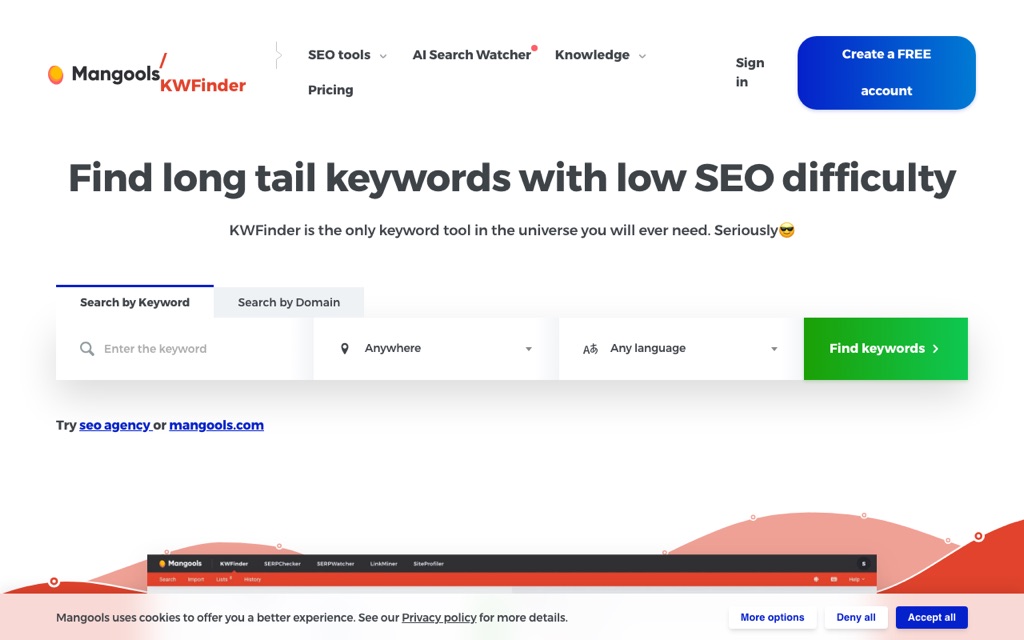
So I rebuilt from zero, this time doing the keyword research with my own hands. And the very first tool that actually made SEO feel approachable for me, a self-taught operator on a budget, was Mangools. This is my honest review, backed by the numbers I've watched in my own GA and Search Console accounts.
Here's what I'll cover:
- What Mangools actually is, and what its 5 bundled tools do
- Why it's the best fit for budget-conscious bloggers and small businesses
- A step-by-step walkthrough of keyword research in KWFinder
- Pricing in USD, and how it compares head-to-head with Ahrefs and Semrush
- The honest pros and cons, including where it genuinely falls short
- Which of the three platforms you should actually pick
What Is Mangools? Five SEO Tools in One Subscription
If Ahrefs and Semrush are giant department stores, where you can buy anything but you'll wander the aisles for an hour and pay for things you'll never touch, then Mangools is the well-curated boutique. Founded in Slovakia back in 2014, it does a small number of things and does them cleanly. Every single plan, even the cheapest one, unlocks all five tools.
Here's what you get:
- KWFinder (keyword research) — Type in a keyword and get a list of related terms with search volume and difficulty scores. This is the tool that tells you whether a keyword is even worth writing about. It's the star of the show.
- SERPChecker (SERP analysis) — Look at the current top 10 ranking pages for a query and see how authoritative they are, so you can judge whether you actually have a shot at breaking in.
- SERPWatcher (rank tracking) — Monitors your keyword positions daily. Its Dominance Index gives you a single-glance read on your overall visibility.
- LinkMiner (backlink analysis) — Shows you who's linking to your competitors so you can hunt for link-building opportunities of your own.
- SiteProfiler (site overview) — A quick domain authority snapshot, plus a competitor's top content and traffic sources.
New for 2026: Mangools has added an AI Search Watcher to track how your brand shows up in AI-generated answers. Heads up — it's a separate add-on, running roughly $15.60/month on an annual plan, and it's not bundled into the standard five tools.
Why Mangools Is Built for New Bloggers and Small Businesses
I've now recommended Mangools to dozens of people in my circle, and the reasons it keeps winning for beginners are always the same four things.
- The price is genuinely friendly. The entry-level Basic plan runs about $29.90/month on annual billing, and remember, that already includes all five tools. There's no upsell to "unlock" the things you actually need.
- A 10-day free trial with no credit card. This is rarer than it should be. Mangools doesn't ask for a card upfront, and when the trial ends, it quietly drops you to a free tier instead of silently charging you. No anxiety, no "cancel before you get billed" mind games.
- It's designed for individuals. Freelancers, solo bloggers, small shop owners — the whole product is shaped around one person doing real work, not a 20-seat enterprise team.
- Strong international and local-language support. Mangools covers 20+ languages and 5,000+ locations, so whether you're targeting searchers in the US, the UK, Germany, or anywhere else, you can pull volume that reflects that specific market instead of a muddy global average.
And the interface deserves its own mention. Everything is color-coded — green difficulty scores mean "go for it," red means "you'll be fighting an uphill battle." The first time I opened KWFinder, I understood what I was looking at within about 90 seconds. Compare that to the first time I opened Ahrefs and felt like I'd walked into a cockpit.
How to Do Keyword Research in KWFinder: A Step-by-Step Walkthrough
This is the part that actually moves the needle on your traffic, so let me walk you through exactly how I use KWFinder when I'm planning a new piece of content.
Step 1: Enter a seed keyword and set your location and language
Start with a topic. Let's say you're building a site about camping gear, so you type in "camping gear." Before you hit search, this part is critical: set your Location and Language to the market you're actually targeting. If you're going after US shoppers, set it to the United States and English. Skip this and you'll get a blended global number that's useless for planning.
Step 2: Watch three numbers
- Search Volume — average monthly searches. If it's in the low single digits, almost nobody is looking for this, and it's probably not worth your time.
- KD (Keyword Difficulty) — a 0–100 score. For a new site with little authority, I tell people to hunt for keywords with KD under 30. That's your beachhead. Once your domain matures, you can climb higher.
- Trend — the 12-month search pattern. This tells you whether a keyword is seasonal (camping spikes every summer) or evergreen (steady year-round). I plan my editorial calendar around this so I publish seasonal pieces a couple of months before the spike.
Step 3: Expand your list three ways
KWFinder gives you three tabs to widen your keyword pool, and I use all of them:
- Suggestions — related variations of your seed keyword.
- Autocomplete — the phrases Google would auto-fill, which mirror real searcher behavior.
- Questions — question-format keywords. These are gold: I turn them straight into H2 and H3 subheadings, which is exactly what helps you show up in featured snippets and AI answers.
Step 4: Validate the opportunity with SERPChecker
This is the step most beginners skip, and it's the one that has saved me the most wasted effort. Before you commit to writing, click through to SERPChecker and look at who's currently ranking in the top 10. If it's all big national brands, Wikipedia, and major news outlets, you're going to lose — move on. But if you spot small blogs and forum threads sitting on page one, that keyword is "soft," and you have a real shot.
Why this step pays for itself: When I started running every keyword through SERPChecker before writing, I cut my "wrote it, never ranked" failure rate dramatically. In my own GA, the articles I published after adding this validation step were the ones that actually pulled in organic traffic. Writing without checking the SERP is just gambling with your time.
One honest caveat on data quality: for any language outside of English, search-volume numbers are inherently a little less precise across the whole industry, simply because there's less raw data to model from. I treat KWFinder's numbers as solid relative signals — great for ranking keywords against each other — and I cross-check the big ones against Google Keyword Planner. Use it for direction, not for gospel.
Mangools Pricing vs. Ahrefs vs. Semrush
This is where the value gap gets almost comical. I've put real money into all three of these platforms over the years, so here's the honest side-by-side in USD.
| Plan | Price (approx./month) | Best for |
|---|---|---|
| Mangools Basic | ~$29.90 (annual) | Individuals, bloggers, freelancers — all 5 tools included |
| Mangools Premium | ~$44.90 (annual) | Growing small teams |
| Mangools Agency | ~$89.90 (annual) | SEO agencies and resellers |
| Ahrefs Starter | $29 (monthly only) | A deliberately limited entry tier |
| Ahrefs Lite | ~$103 | Advanced individuals / small business |
| Semrush Pro | ~$117 | Advanced marketers and small teams |
Read that table again. The full-featured Mangools Basic plan costs roughly one-quarter of Semrush Pro and well under one-third of Ahrefs Lite. And unlike Ahrefs Starter, which is intentionally hobbled, Mangools Basic gives you the complete toolkit. For someone in the first year or two of building a site, that price difference isn't a rounding error — it's the difference between affording a tool and not.
Pro tip: Mangools' annual billing knocks 30–40% off the monthly rate. But don't just smash the "buy annual" button. Use the full 10-day free trial first, run real keyword research for your actual niche, and only commit to the year once you're confident it fits your workflow.
The Honest Pros and Cons
No tool is perfect, and the data guy in me refuses to write a fake puff piece. Here's the real ledger.
What I love
- Genuinely affordable, with all five tools bundled into every plan — no paywalled essentials.
- The most beginner-friendly interface I've used in this category, full stop.
- KWFinder's KD score has a strong reputation for accuracy, and it's matched my real-world ranking outcomes well.
- A 10-day free trial with no credit card required and no auto-charge ambush.
- Solid multi-language and location targeting, so your volume data reflects the market you actually serve.
Where it falls short
- Daily query limits. The Basic plan caps how many lookups you can run in a 24-hour window. If you do marathon keyword-research sessions, you can hit the ceiling.
- A smaller backlink database. LinkMiner is useful, but its link index is meaningfully smaller than Ahrefs', which still leads the industry. For serious, large-scale competitive link analysis, it's not enough.
- No advanced technical features. There's no full site audit, no PPC tooling, no social media management, no deep technical-SEO suite. Mangools deliberately stays in its lane.
The fairest way I can describe Mangools: it gives you the 80% of features beginners actually use, at 20% of the price.
Mangools vs. Ahrefs vs. Semrush: Which Should You Choose?
People ask me this constantly, so here's my decision framework. It really comes down to where you are right now.
- Choose Mangools if you're a new blogger, a solo operator, or a small business owner on a tight budget who mainly needs keyword research and rank tracking. This is the overwhelming majority of people reading this.
- Choose Ahrefs if you already have SEO experience, you specifically need deep and broad backlink analysis, and you can comfortably spend $100+ a month.
- Choose Semrush if you need an all-in-one marketing command center — PPC, competitor intelligence, content marketing, the works — and you have the budget to match.
My honest take for 90% of you: If you're in the first stretch of building a site, you are simply not at the stage where you need Ahrefs or Semrush yet. Build your fundamentals with Mangools, get a real feel for keyword research, and upgrade later — when your needs are genuinely complex enough to justify quadruple the cost.
Who Mangools Is (and Isn't) For
Mangools is a great fit if you're a:
- New blogger or content creator
- Solo operator or freelancer
- Small business or local shop owner
- SEO learner who wants to avoid a big early spend while you're still figuring things out
Look elsewhere if you're a:
- Advanced practitioner who needs deep competitive backlink analysis
- Power user running heavy daily keyword research who'd bump into the query caps
- Mid-to-large team needing a comprehensive marketing platform with PPC, social, and full technical suites
Frequently Asked Questions
Does the Mangools free trial really require no credit card?
Correct. You can start the 10-day trial without entering any payment details, and when it ends, your account drops to a limited free tier instead of being charged. It's one of the most no-pressure trials in the SEO space.
Is KWFinder's data accurate enough to rely on?
For English-language markets, yes — its difficulty score in particular has lined up well with my real ranking results. For other languages the numbers are a bit less precise (that's an industry-wide limitation, not a Mangools flaw). My advice: use it for relative comparisons and cross-check your most important keywords against Google Keyword Planner.
Can Mangools replace Ahrefs or Semrush entirely?
For a beginner or solo blogger, for a good while, yes. The place it can't replace them is deep, large-scale backlink analysis and all-in-one marketing features. When you reach the point where you genuinely need those, you'll know — and you can graduate up then.
Final Verdict
If you're anything like I was back in 2020 — burned by an expensive black box you couldn't understand or control — then Mangools (KWFinder) is, without a doubt, the highest-value entry-level SEO tool I can point you to. It hands you the keys to your own data, in an interface you can actually read, for a price that won't sting.
The best part is that there's genuinely nothing to lose. The trial is free, it doesn't ask for a card, and 10 days is more than enough to research your whole content calendar. Go open an account, run your real keywords through it, and see for yourself. Worst case, you walk away with a free keyword list. That's the kind of risk-free bet I wish someone had handed me six years ago.
Want to see how Mangools stacks up against the rest of the field? I keep a running breakdown of my favorite platforms over on my SEO tools page.